
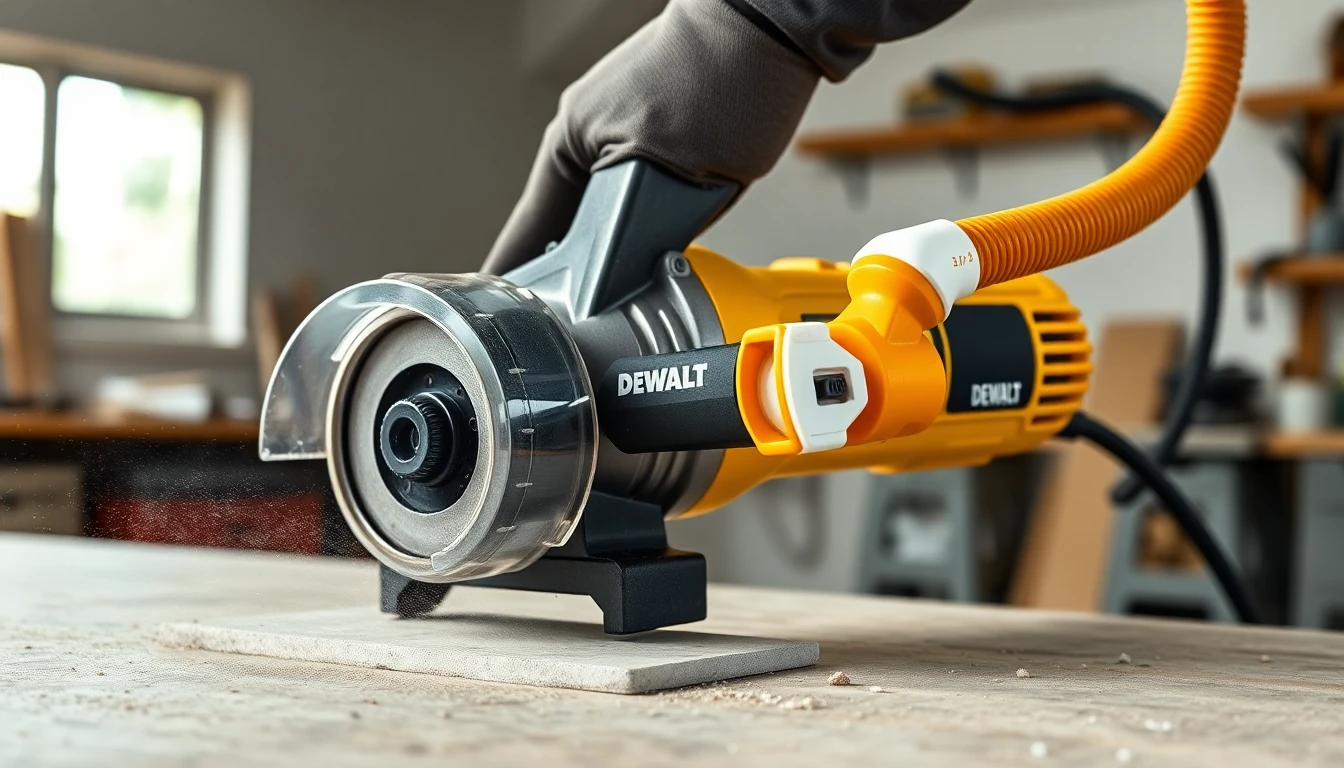
Cutting concrete with an angle grinder is fast. It also fills the air with silica dust. Silica is the kind of dust that scars lungs over time. Once it gets in, it stays. There is no cleanup later.
OSHA has a rule about this. It is called Table 1. The rule says contractors must use either a wet method or a dust shroud paired with a HEPA vacuum when cutting or grinding concrete. Most pros pick the shroud. It is cleaner, faster, and works indoors.
This guide covers the full setup. The shroud picks up the job. The shop vac pulls the dust. The hose adapter connects them. Get any one of those wrong and the whole system leaks.
Be clear on what the adapter does. A GulpDust adapter connects the shroud hose to your vac hose. That is all it does. It is not a shroud. It is not a filter. It does not make your setup OSHA compliant. It does not set the airflow, the filter grade, or the respirator the job needs. Those parts are on you. Check them before any silica job.
Measure Your Shroud Port
Grinder shrouds come with several port styles, from plain friction-fit ports to lock-on ports made for the same maker's vac. Tool makers change port sizes between models. Do not trust a chart. Measure the port on the shroud you own.
Take calipers or a ruler. If the port is an opening, measure across the inside. If it is a stub, measure across the outside. Then measure the end of your shop vac hose. Give us the two numbers and we print the adapter to them. The size guide shows how.
Friction-Fit Ports
A friction-fit port seats a hose by squeeze alone. A shroud port is often much smaller than a 2-1/2 inch shop vac hose, so the two do not mate. Many owners try a step-down adapter from the shop vac aisle. Those work but tend to leak at both joints, because they are sized for shop vac wands, not shrouds. A printed PETG adapter sized to match your shroud port and your shop vac hose seats snug on both ends. No tape, no clamps.
Lock-On Ports
Some shrouds use a lock-on boss, such as a quarter-turn or click lock, made to pair with the same maker's vac. If you do not own that vac, the boss will not fit a standard hose. Tell us what kind of lock your shroud has and measure the boss. Check your brand page for more: DeWalt, Milwaukee, Bosch, and Makita.
Starting Points
If you want to compare your reading, the port size pages show what we print at each size: the 1-1/4 in. size page, the 35mm size page, and the 27mm size page. Your own measurement is what decides the part.
Universal Angle Grinder Vacuum Attachment Sizes
Universal clamp-on shrouds from Dustless Technologies, Bauer, and the no-name Amazon brands fit a wide range of grinders. They slide over the gear case and tighten with a hose clamp. One body fits many grinders. The trade-off is the hose port: it is almost never the same size as your shop vac hose.
Standard US shop vac hoses are sold as 1-1/4 inch, 1-7/8 inch, or 2-1/2 inch on the inside. Shroud ports come in sizes of their own, and nothing lines up by chance. Measure both ends.
A printed PETG adapter sized for the exact shroud port and the exact shop vac hose closes the gap. Our hose size adapter guide shows how to match a hose to a tool port. The port size pages are another starting point.
4-1/2 vs 5 vs 7 Inch Grinder Dust Shrouds
Grinder size changes everything about the setup. A 4-1/2 inch grinder is a one-hand tool for small cuts. A 7 inch grinder is a two-hand tool for serious concrete work. The shroud has to match.
- 4-1/2 inch shrouds: Fit the most common DIY grinder. Light. Easy to swap. Best for small concrete repairs and tile mortar removal.
- 5 inch shrouds: The middle ground. Fits the same body as a 4-1/2 inch grinder with a slightly bigger wheel. Most universal shrouds list this as the sweet spot.
- 7 inch shrouds: Bigger, heavier, and built for crack chasing and saw cuts. The dust load is higher, so the port is usually a size up.
Surfacing shrouds are a separate category. They sit flat on the workpiece and pair with cup wheels and diamond grinding discs, not cutoff wheels. Use one for floor prep, paint removal, or thinset cleanup. A surfacing shroud on a cutoff wheel will catch the blade; a cutoff shroud on a cup wheel cannot seal. Pick the shape that matches the wheel.
Grinder Dust Extractor for Concrete and Silica Work
Concrete contains crystalline silica. So does brick, block, mortar, and most tile substrate. OSHA classifies respirable silica as a carcinogen and limits exposure on the job site.
OSHA Table 1 and the HEPA Requirement
OSHA Table 1 gives contractors a compliance path for cutting and grinding silica-bearing materials. The two approved options are a wet method or a dust shroud paired with a dust extractor that has a true HEPA filter. Most pros pick the shroud path because it works indoors and does not leave water on the slab.
A true HEPA filter captures 99.97% of dust at 0.3 microns. A standard shop vac filter does not meet that spec. If your vac does not say HEPA on the box, it is not approved for silica work.
Dustless Grinder Setup with HEPA Shop Vac
A dustless grinder setup has three parts. The shroud catches the dust at the wheel. The hose carries it away. The vac holds it in a HEPA-rated filter.
Picking a Shop Vac That Meets the Spec
Three things matter when picking the vac. First, a true HEPA filter sealed at the gasket. Second, airflow of at least 130 CFM at the hose end. Third, an auto-start outlet so the vac kicks on when the grinder pulls the trigger. You only have one hand free during a cut.
Vacs that hit all three: the Festool CT 26 E HEPA, the DeWalt DWV012, the Bosch VAC090A, and the Makita XCV11Z (cordless). All four meet the HEPA vacuum spec for OSHA Table 1 grinder pairing when used with a proper shroud. The printed adapter is not part of that rating. It only connects the hose.
Common Setup Mistakes
Most setups fail the same handful of ways. Knowing them ahead of time saves a few wasted Saturdays.
- Skipping the HEPA filter: A standard shop vac filter passes silica back into the room. You feel it in your chest the next morning.
- Duct tape on the shroud port: Tape pulls free after a few cuts. The seal goes from tight to leaky in one job.
- Using a too-small hose: A 1-1/4 inch hose throttles airflow. The shroud loses suction. Dust escapes around the wheel.
- Wrong shroud for the wheel: A cutoff shroud on a cup wheel cannot seal. A surfacing shroud on a cutoff wheel will catch the blade.
- No auto-start: Running the vac all the time wastes filter life and battery. Auto-start fires the vac only when the grinder runs.
Cordless Grinder Plus Cordless Shop Vac Pairings
Cordless grinder paired with a cordless shop vac is the cleanest jobsite setup. No extension cords, no GFCI tripping. Three pairings that work well:
- Milwaukee M18 FUEL grinder with the M18 FUEL shop vac (0882-20). Both run on the same battery line.
- DeWalt 20V MAX or 60V FLEXVOLT grinder with the DeWalt DCV517B vac. Same battery family.
- Makita XGT 40V grinder with the Makita XCV11Z (40V) vac. Strong suction for a cordless unit.
Cordless vacs often have a smaller hose end than corded units. Measure it and plan on a printed adapter made to your numbers. For more on cordless dust collection across brands, see our cordless guide.
Picking the Right Shroud for the Job
Match the shroud to the work, not to the wheel size alone.
- Tile mortar removal: 4-1/2 inch cutoff shroud, paired with a 130 CFM shop vac. A small diamond blade and a HEPA filter take care of the rest.
- Concrete crack chasing: 5 inch cutoff shroud. The deeper cut needs the bigger wheel. Pair with a strong CFM vac.
- Floor paint or thinset removal: Surfacing shroud with a cup wheel. The flat base sits on the floor. Use a vac with a long hose so you can drag it.
- Brick or block grinding: 5 inch or 7 inch cutoff shroud. Brick dust contains silica too. Same HEPA setup applies.
- Steel cutting: Skip the shroud unless sparks are an issue. A magnetic chip pan plus a face shield is enough for most steel cuts.
Grinder dust is not the only fine dust in a shop. MDF dust and silica dust are both classed as carcinogens by OSHA. If you also cut MDF on a table saw or trim it on a router, the same HEPA vac and adapter strategy applies. Read our guide to dust collection for MDF and plywood for the woodworking side of the same setup.
Why PETG Beats PLA for Grinder Adapters
Grinder work runs hot. The shroud sits inches from a spinning wheel. Heat builds up fast. A PLA adapter starts to soften at 60 degrees Celsius. PETG holds up to 80 degrees Celsius. That gap matters when the work is concrete.
Concrete cutting heats the shroud through friction. A PLA adapter near that heat will warp inside one job. The fit goes from snug to loose, and dust starts leaking back through the joint. PETG holds shape through hundreds of cuts and shrugs off shop solvents like brake cleaner and acetone, which is useful when cleaning a shroud after a long session.
For the full story on material choice, see why we use PETG for every adapter. For more on why we skip PLA and ABS entirely, see why GulpDust adapters are PETG, not PLA or ABS.
Angle grinder dust collection works when three parts line up. The shroud matches the wheel. The vac pulls hard enough. The hose connects with a snug fit. Most pros own the first two parts and lose at the hose. A printed PETG adapter closes the gap. One part, one fit, no tape.
If you tell us the measurement across your shroud port and the measurement across your shop vac hose, we will print you the adapter that connects them. Made in the USA, printed to order and shipped from the USA.